
Refractory Ceramic Fibre Paper – CCEWOOL®
- 02 Dec, 2025
- Insight

In high-temperature sealing, insulation gaskets, battery thermal management, and furnace gasketing systems, flexibility is not just a material feature — it determines processing efficiency, sealing integrity, and long-term reliability. Unlike conventional ceramic papers that crack, delaminate, or shed dust during bending, CCEWOOL® Refractory Ceramic Fibre Paper delivers higher flexibility, cleaner processing, and stable formability under repeated deformation.
This flexibility is not accidental — it is the result of precision raw-material selection, controlled fibre architecture, and optimized forming methodology.
High-Purity Fibre System: Flexibility Begins at the Source
Flexibility originates from fibre morphology. CCEWOOL® uses a high-purity long-fibre alumino-silicate formulation, ensuring fibres are fine, continuous, and highly extensible — rather than short or coarse fibres.
As supported by high-temperature fibre mechanics studies:
The more uniform the fibre length and fineness, the better the macroscopic flexibility and stress-distribution behaviour during bending.
By applying:
1500–1550°C controlled melting
Precision high-speed fibreizing
CCEWOOL® significantly reduces shot content and creates a continuous fibre network — eliminating hard points that trigger fracture during bending.
This forms the foundation of material flexibility.
Engineered 3D Fibre Structure: The Key to Bendability Without Delamination
Flexibility is not only about material chemistry — it is about structure.
During forming, CCEWOOL® applies:
Multi-directional fibre orientation control
Layer-to-layer continuous deposition
Low-disturbance fibre delivery
This produces a stable three-dimensional fibre skeleton with controlled mobility between fibres.
The result:
Bends without cracking
Punches without fraying
Rolls without delamination
Maintains structure under repeated deformation
Flexibility becomes repeatable and durable, not a one-time property.
Optimized Binder Matrix: Flexible — Not Soft, and Not Brittle
Some ceramic papers are soft but break easily — evidence of a brittle binder phase.
CCEWOOL® solves this through a flex-engineered inorganic binder system designed to:
Maintain controlled fibre slip during strain
Preserve mechanical strength after heating
Prevent stiffening or embrittlement during curing and use
Thermal-cycling and folding tests prove that the fibre paper retains strength and integrity — even after exposure to elevated temperatures.
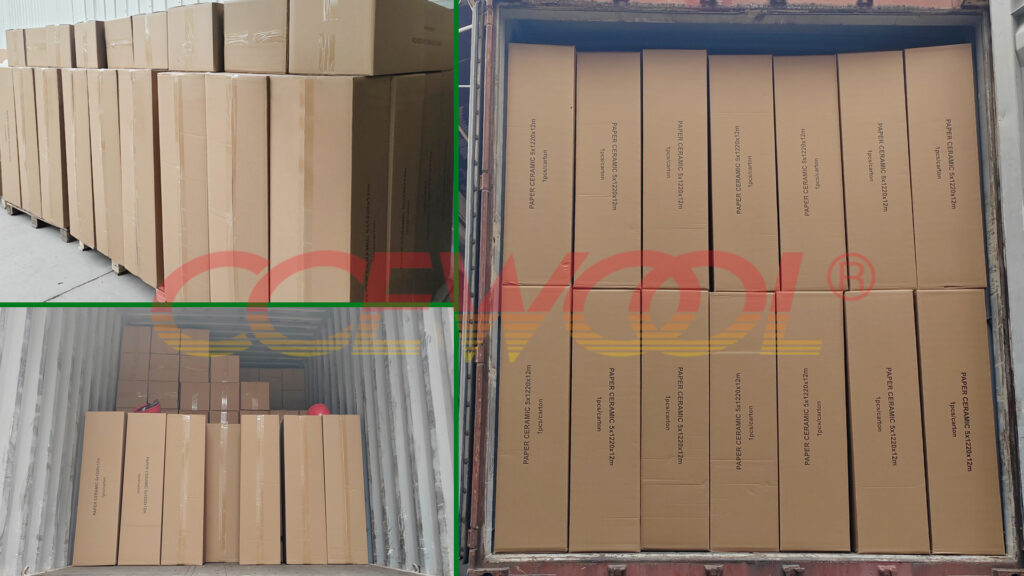
Polish Customer
Cooperation years: 10 years
Ordered product: CCEWOOL Refractory Ceramic Fibre Paper
Product size: 3x1220x20000mm / 5x1220x12000mm
The customer emphasizes flexibility as a core requirement and confirms:
“CCEWOOL® fibre paper cuts cleanly, bends without cracking, rolls without dusting, and seals more efficiently.”
Long-term production feedback is a stronger proof than laboratory data — and CCEWOOL® has passed both.
Flexibility Is the Bridge Between Processability and Durability
The superior flexibility of CCEWOOL® Refractory Ceramic Fibre Paper is the result of: A high-purity fibre system, Low-shot content fabrication, A three-dimensional fibre reinforcement network, A flexible, high-temperature inorganic binder matrix.
This enables the paper to bend, wrap, stamp, seal, and withstand industrial-grade thermal cycling — without cracking, shedding, or delaminating.


