
Ceramic Fiber Block Design for Push-Type Continuous Reheating Furnaces
- 11 Feb, 2026
- Industry
Push-type continuous reheating furnaces are primarily used to reheat steel billets, continuously cast slabs, and similar materials to the temperatures required for hot rolling. They are core thermal processing equipment in the steel industry. The furnace body typically has a long, linear structure, with different temperature zones arranged along the furnace length. Steel billets are pushed forward by a pusher mechanism along the furnace hearth skid rails and, after heating, are discharged from the furnace end or through a side wall outlet.
According to the thermal regime and furnace structure, push-type continuous reheating furnaces are generally classified into two typical types: two-zone and three-zone furnaces.
In a two-zone push-type reheating furnace, the furnace is divided along its length into a preheating zone and a heating zone. The preheating zone typically operates at temperatures of approximately 800–1100 °C, while the heating zone operates at higher temperatures and is responsible for raising the billet temperature to the required level.
A three-zone push-type reheating furnace further divides the furnace into a preheating zone, a heating zone, and a soaking zone, with more clearly defined temperature distributions:
Preheating zone: 850–950 °C, with a maximum not exceeding 1050 °C
Heating zone: 1320–1380 °C
Soaking zone: 1250–1300 °C
The temperature level and operating characteristics of each zone directly determine the grade selection of high-temperature insulation fiber products and the corresponding lining structure design.
In actual operation, push-type continuous reheating furnaces do not always run under fully stable conditions. During furnace start-up, shutdown, and operating adjustments, the furnace lining experiences frequent heating and cooling cycles, and heat storage losses become significant. Compared with traditional dense refractory materials, high-temperature insulation fibers offer clear advantages such as rapid heating and cooling response, low heat storage, and lightweight structure. These characteristics are especially beneficial for energy-efficient operation and automated control systems, making high-temperature insulation fibers an indispensable component of modern push-type reheating furnace lining systems.
Lining Structure and High-Temperature Insulation Fiber Applications in Different Furnace Zones
Preheating Zone Lining Structure
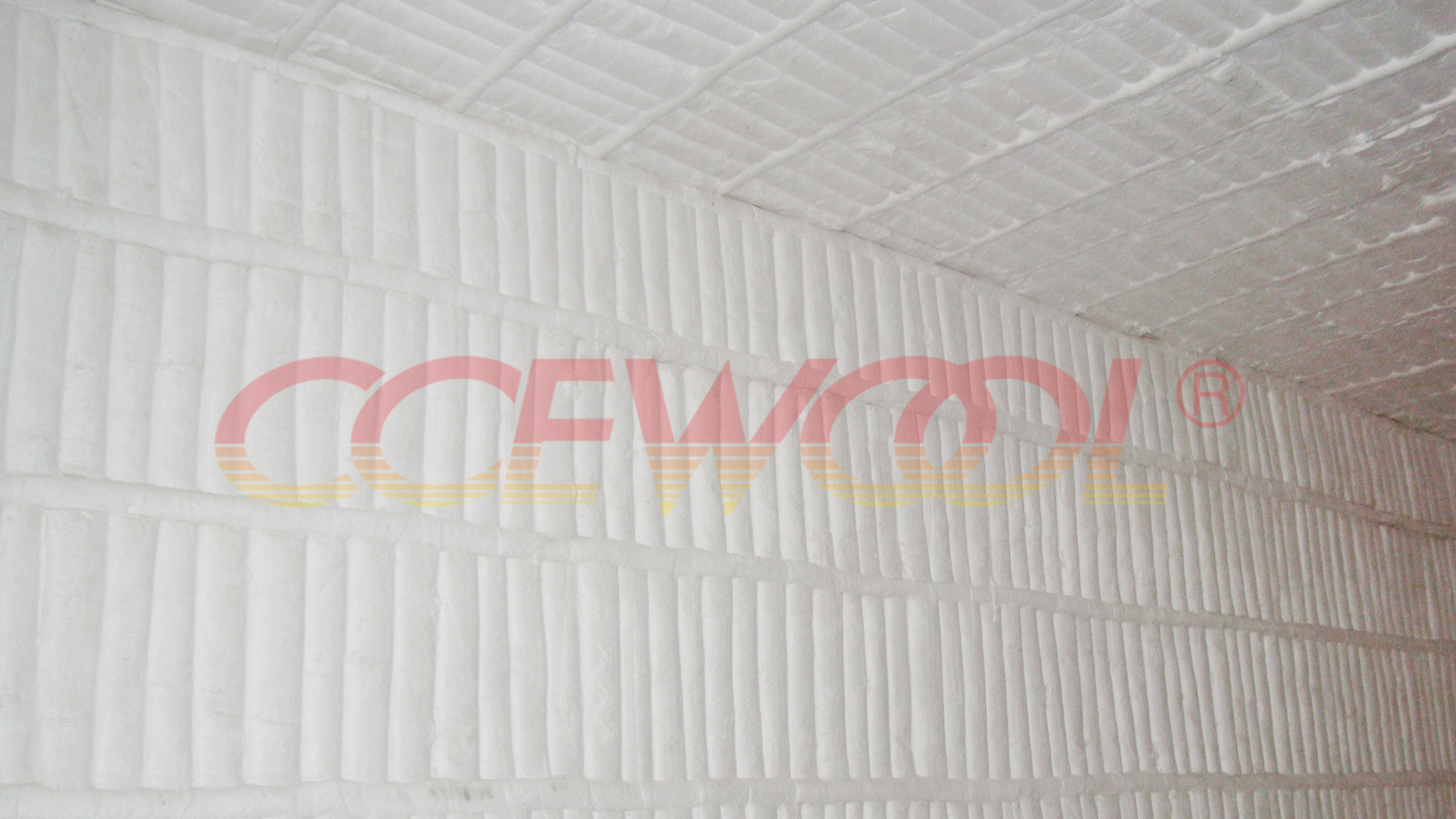
Although the preheating zone operates at relatively lower temperatures, it extends over a long section of the furnace and is one of the areas where high-temperature insulation fibers are most extensively applied. A composite lining structure consisting of flat-laid ceramic fiber blankets combined with stacked ceramic fiber block is commonly adopted to balance insulation performance and structural stability.
Backup Insulation Layer
The backup layer is constructed using flat-laid CCEWOOL® 1260 °C ceramic fiber blankets. Supplied in roll form, the blankets are unrolled, straightened, and pressed tightly against the furnace shell steel plate. They are secured by welded heat-resistant stainless-steel anchors in combination with speed clips. This layer primarily provides thermal insulation while also offering a continuous and stable support base for the hot-face working layer.
Working Layer
The working layer typically uses angle-iron–type or hanging-type CCEWOOL® 1260 °C ceramic fiber block. The modules are installed in the same orientation along the folding direction. Between adjacent rows of modules, CCEWOOL® 1260 °C ceramic fiber blankets of the same grade are folded into a U-shape and inserted to compensate for fiber shrinkage during high-temperature operation. This design helps prevent gaps between modules and ensures the overall continuity of the lining structure.
Furnace Roof Structure
For the furnace roof, two layers of CCEWOOL® 1260 °C ceramic fiber blankets are first laid flat as the backup insulation layer. Above this, CCEWOOL® 1260 °C ceramic fiber block with a single-hole hanging anchor structure are installed. This configuration effectively reduces roof load while maintaining the integrity and long-term stability of the insulation layer in high-temperature areas.
Heating Zone Lining Structure
The heating zone is one of the highest-temperature areas in the furnace and is characterized by a complex internal atmosphere. In this zone, high-temperature insulation fibers are primarily used as backup insulation layers rather than as direct hot-face materials.
The furnace wall backup insulation layer typically adopts a flat-laid structure using CCEWOOL® 1430HZ ceramic fiber blankets. The blankets are installed in close contact with the furnace shell steel plate, effectively blocking heat transfer from the high-temperature interior to the outside of the furnace. This configuration helps lower the external shell temperature and reduce system heat losses, while also avoiding structural risks associated with excessively thick fiber layers in high-temperature zones.
Soaking Zone Backup Insulation Structure
The soaking zone operates at elevated temperatures over long periods, placing higher demands on material stability and service life.
In this zone, the backup insulation layer commonly uses CCEWOOL® PUREWOOL ceramic fiber products or 1400LZ ceramic fiber products. Their primary functions are to reduce furnace shell temperature, lower overall energy consumption, and maintain stable insulation performance under long-term operating conditions.
Hot Air Duct Insulation
Hot air ducts typically have complex geometries with multiple bends, requiring materials with good flexibility and conformity.
CCEWOOL® 1260HPS ceramic fiber blankets are commonly used for insulation wrapping or as laid linings for hot air ducts. The blankets can closely conform to the duct surface, effectively reducing heat loss while simplifying installation procedures.
Typical Insulation Thickness Configuration (Reference)
Preheating zone insulation thickness: 220–230 mm
Heating zone backup insulation layer: 40–60 mm
Furnace roof backup insulation layer: 30–100 mm
In push-type continuous reheating furnaces, high-temperature insulation fibers are not merely substitutes for traditional refractory materials. Instead, through zone-specific material selection, function-oriented layout, and composite structural design, they enable a well-balanced combination of insulation performance, structural reliability, and construction efficiency.
By scientifically applying CCEWOOL® ceramic fiber block and ceramic fiber blanket products in key areas such as the preheating zone, heating zone, soaking zone, and hot air ducts, it is possible to significantly reduce furnace heat losses, minimize heat storage consumption, and enhance the overall operational flexibility and energy efficiency of push-type continuous reheating furnaces.


