
Customer Feedback | Swiss Customer Highly Praises CCEWOOL® Ceramic Fiber Vacuum Formed Shapes
- 24 Dec, 2025
- Company
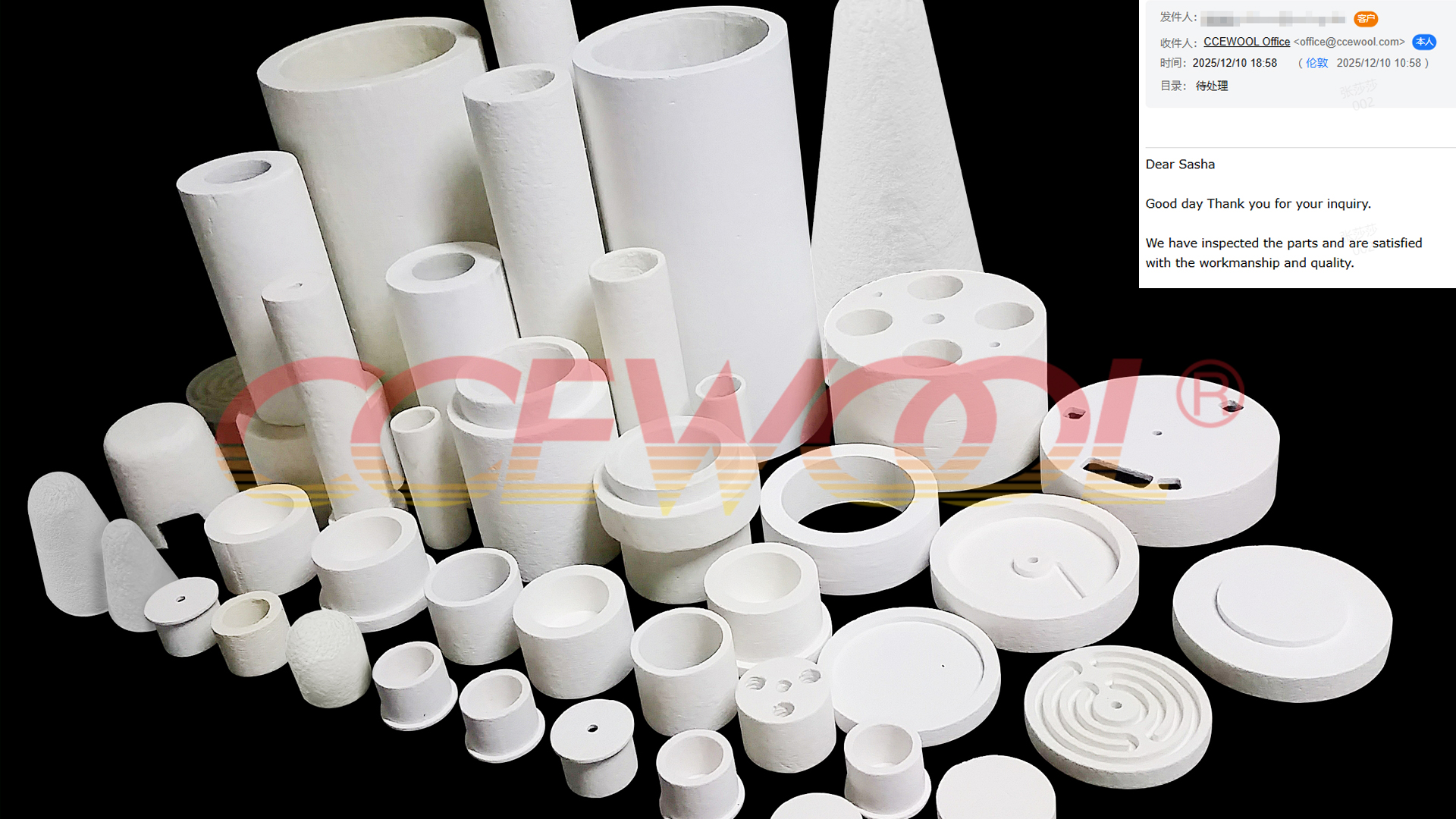
Recently, CCEWOOL® received positive feedback from a Swiss customer, expressing high satisfaction with the Ceramic Fiber Vacuum Formed Shapes supplied. This feedback not only confirms the quality of a specific shipment, but also reflects CCEWOOL®’s proven manufacturing capability and quality consistency in precision-formed fiber components.
Customer Feedback
“We have inspected the parts and are satisfied with the workmanship and quality.”
This concise statement clearly reflects the customer’s recognition of the product’s detailing, structural integrity, and overall quality after inspection.
Vacuum Forming Technology Ensures Structural Consistency and Dimensional Accuracy
CCEWOOL® Ceramic Fiber Vacuum Formed Shapes are manufactured using a mature vacuum forming process, in which fibers are uniformly deposited into molds under controlled suction. This method allows precise control of wall thickness consistency and structural integrity, ensuring complex shapes remain stable and well-defined after forming.
This process is especially suitable for high-temperature insulation and protection components that require high dimensional accuracy and structural stability.
2-Hour Rapid and Thorough Drying for Long-Term Stability
After forming, CCEWOOL® applies a 2-hour rapid and thorough drying process to the vacuum formed shapes. With precisely controlled temperature and airflow distribution, the products achieve deep, uniform drying within a short time, ensuring that internal moisture is fully removed rather than remaining on the surface.
This process effectively reduces residual internal stress and helps maintain dimensional stability and structural reliability during high-temperature service—an important factor behind the customer’s positive evaluation of workmanship and quality.
Fully Automated Intelligent Equipment for Precision and Consistency
To meet the high standards of European customers regarding manufacturing precision and consistency, CCEWOOL® extensively utilizes fully automated intelligent equipment throughout the vacuum forming and post-processing stages. This ensures:
Precise dimensional control with stable tolerances
Clean, well-defined edges and consistent detailing
High batch-to-batch consistency, facilitating installation and replacement
In addition, CCEWOOL® offers customized vacuum formed solutions based on customer drawings or application requirements, meeting the needs of different equipment designs and operating conditions.
Customer Recognition Built on Stable Processes and Verifiable Quality
The Swiss customer’s positive feedback on CCEWOOL® Ceramic Fiber Vacuum Formed Shapes is the result of consistent forming technology, controlled drying processes, and precision manufacturing. CCEWOOL® remains committed to delivering high-temperature fiber formed products with reliable quality that withstand real-world inspection.
Looking ahead, CCEWOOL® will continue to leverage its mature vacuum forming technology and intelligent manufacturing systems to provide accurate, dependable, and long-term stable ceramic fiber formed solutions for customers worldwide.


